
(7-4-26) Alexander Rowley (22) of Celina was recently booked into the Auglaize County Jail on several charges involving nitrous oxide.
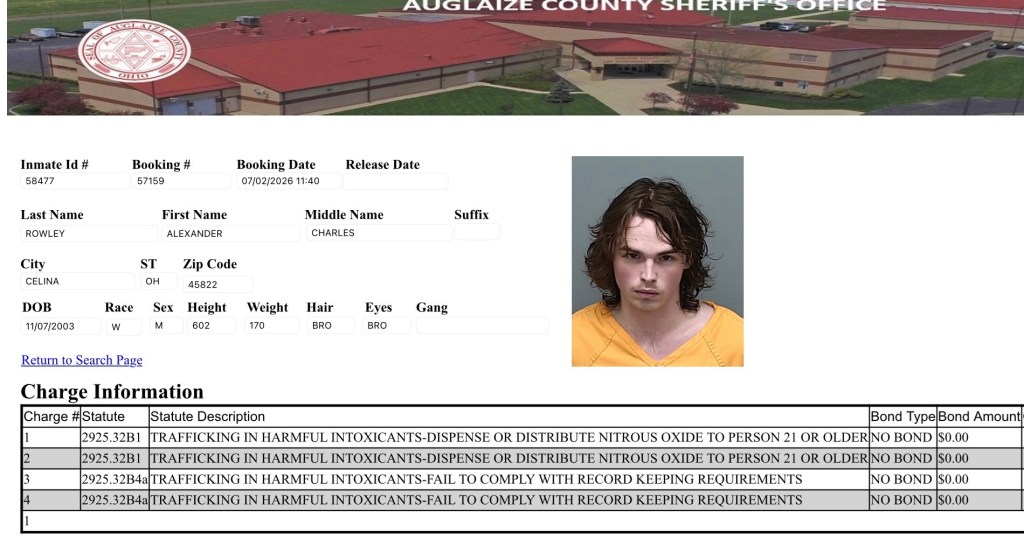
Nitrous oxide is a colorless gas that blocks pain signals in the brain, creates feelings of euphoria and relaxation, and wears off within minutes. Often called “laughing gas,” it works differently from most anesthetics: instead of enhancing the brain’s calming signals, it blocks excitatory receptors that transmit pain and sensory information. That distinction explains both its unique effects and its limitations.
Possible penalties
(B)(1) No person shall knowingly dispense or distribute nitrous oxide to a person age twenty-one or older if the person who dispenses or distributes it knows or has reason to believe the nitrous oxide will be used in violation of section 2925.31 of the Revised Code.
(2) Except for lawful medical, dental, or clinical purposes, no person shall knowingly dispense or distribute nitrous oxide to a person under age twenty-one.
(3) No person, at the time a cartridge of nitrous oxide is sold to another person, shall sell a device that allows the purchaser to inhale nitrous oxide from cartridges or to hold nitrous oxide released from cartridges for purposes of inhalation. The sale of any such device constitutes a rebuttable presumption that the person knew or had reason to believe that the purchaser intended to abuse the nitrous oxide.
(4) No person who dispenses or distributes nitrous oxide in cartridges shall fail to comply with either of the following:
(a) The record-keeping requirements established under division (F) of this section;
(b) The labeling and transaction identification requirements established under division (G) of this section.
(C) This section does not apply to products used in making, fabricating, assembling, transporting, or constructing a product or structure by manual labor or machinery for sale or lease to another person, or to the mining, refining, or processing of natural deposits.
(D)(1)(a) Whoever violates division (A)(1) or (2) or division (B)(1), (2), or (3) of this section is guilty of trafficking in harmful intoxicants, a felony of the fifth degree. If the offender previously has been convicted of a drug abuse offense, trafficking in harmful intoxicants is a felony of the fourth degree.
A presumption of innocence means that any defendant in a criminal trial is assumed to be innocent until they have been proven guilty. As such, a prosecutor is required to prove beyond a reasonable doubt that the person committed the crime if that person is to be convicted. To do so, proof must be shown for every single element of a crime.

