
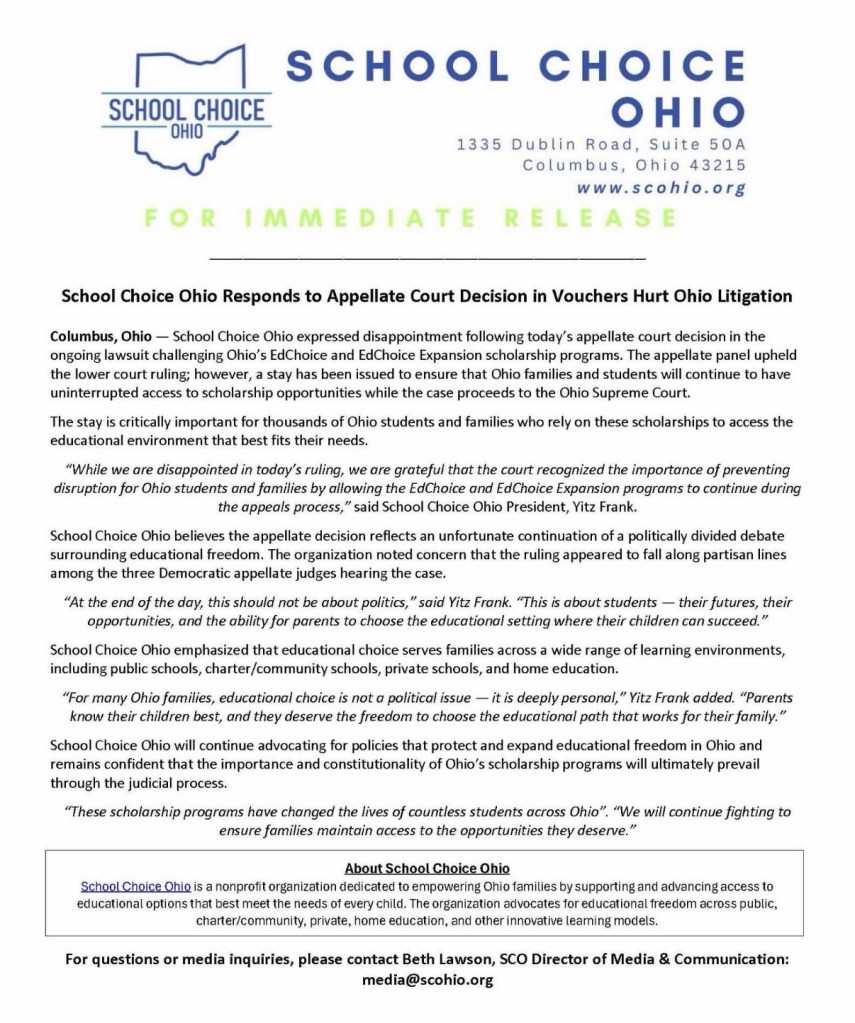
(10-15-26) Ohio’s private school voucher program is unconstitutional, a state appeals court ruled Thursday — but it will remain in place while the state takes the fight to the Ohio Supreme Court.
The 10th District Court of Appeals in Columbus unanimously upheld a Franklin County trial court decision that the EdChoice voucher programs violate the Ohio Constitution. The panel — Judges David Leland, Kristin Boggs and Shawn Dingus — ruled 3-0.
The decision
The ruling covers both the original EdChoice program (created in 2005 for students in lower-performing school districts) and EdChoice Expansion, which lawmakers broadened in 2013 and again in 2023 to make nearly every Ohio student eligible, with voucher amounts tied to household income.
Judge Leland, who authored the decision, wrote that the program spends over $1.4 billion in taxpayer dollars to fund a competing system of private schools with less state oversight — “at the expense and detriment of Ohio’s public schools.” The court also rejected the state’s argument that vouchers support parents rather than schools, noting private schools retain the power to reject students.
The lawsuit
The challenge was brought by Columbus City Schools and other school districts, a statewide school-funding coalition (Vouchers Hurt Ohio and the Coalition for Equity & Adequacy of School Funding), and individual students — more than 300 public school districts in all.
What happens next
The court stayed enforcement of its decision, so more than 100,000 Ohio families using vouchers will see no immediate impact. Attorney General Andy Wilson is expected to appeal to the Ohio Supreme Court, where families represented by the Institute for Justice and EdChoice Legal Advocates have also vowed to defend the program.
Ohio House Speaker Matt Huffman (R-Lima) said he “strongly condemns” the ruling, noting that school choice programs have been affirmed by the U.S. Supreme Court and the Ohio Supreme Court over the past several decades. Senate Democratic Leader Nickie Antonio applauded the decision, saying vouchers fund private and religious schools that “remain unaccountable without the same transparency required of our public schools.”

