
COLUMBUS — Gov. Mike DeWine signed Senate Bill 214 into law Tuesday, removing short-barreled rifles, short-barreled shotguns and firearm suppressors from Ohio’s list of “dangerous ordnance” — and with them, the state registration requirements that had made possessing one without federal paperwork a felony.
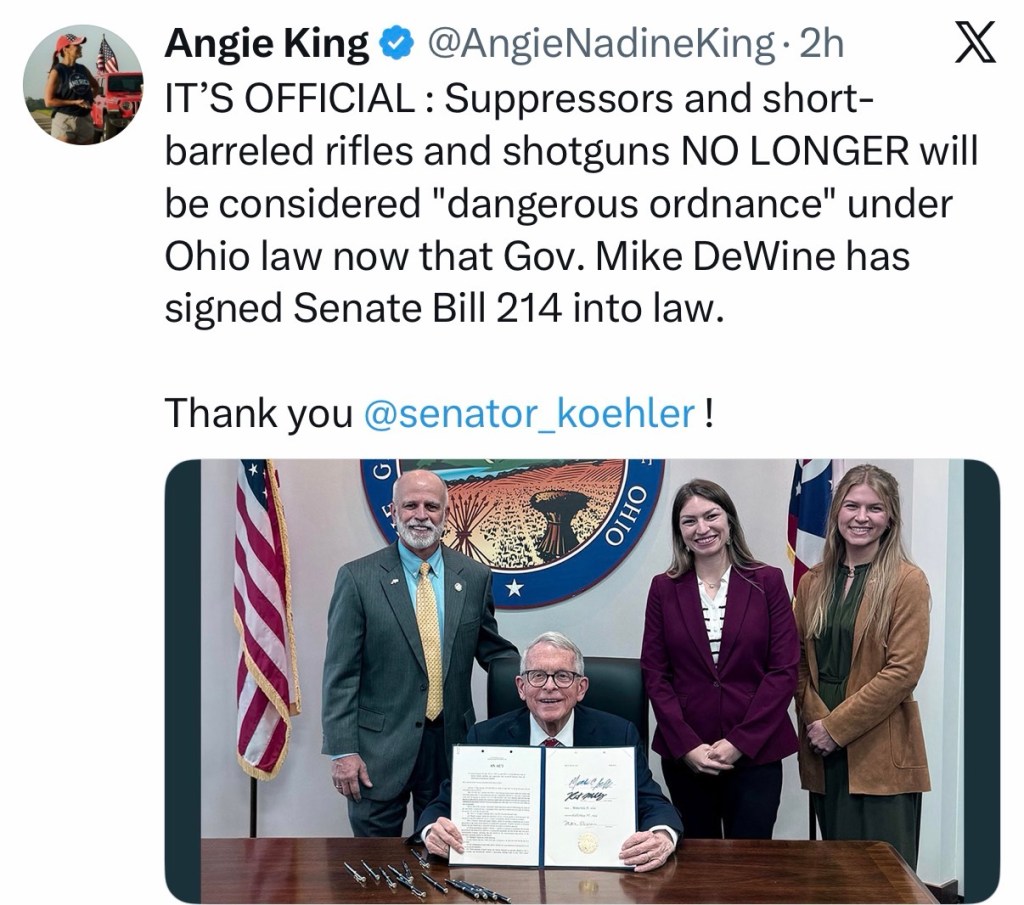
The bill, sponsored by Sen. Kyle Koehler, R-Springfield, amends the Ohio Revised Code so that suppressors — often called silencers — and what Ohio law calls “sawed-off firearms” are no longer classified alongside nitroglycerin, rocket launchers, grenades and torpedoes. Under current law, acquiring, having, carrying or using one of those items without the federal exemption was a fifth-degree felony.
The change does not take effect the day the governor signed it. With no emergency clause in the bill, SB 214 takes effect 90 days after it is filed with the Secretary of State — late February 2027. Until then, current Ohio law still applies.
Why now
Ohio lawmakers moved after a series of changes at the federal level left the state’s law out of step with Washington.
Effective Jan. 1, President Donald Trump’s “One Big Beautiful Bill” eliminated the $200 federal tax on short-barreled rifles, short-barreled shotguns and suppressors. In August, a federal judge in Texas ruled the extra fees and registration weren’t required, and the Trump administration did not appeal. Then on Oct. 9, the Bureau of Alcohol, Tobacco, Firearms and Explosives announced that individuals no longer had to wait for approval, register or pay a $200 tax on those items.
That left Ohio gun owners in a bind: the federal government had stopped requiring registration, but Ohio law still conditioned lawful possession on being registered in the federal National Firearms Registration and Transfer Record. Attorney General Andy Wilson urged lawmakers to bring state law in line with the federal changes.
“I want to thank Gov. DeWine for signing SB 214 which aligns Ohio law with new federal guidelines,” Koehler said. “By doing so, we ensure that law abiding gun owners are not inadvertently turned into felons for attempting to comply with both state and federal law.”
What the bill does — and doesn’t do
Once it takes effect, SB 214 means an Ohioan will no longer be prohibited under state law from acquiring, having, carrying or using a suppressor or a short-barreled rifle or shotgun, and will no longer be required under Ohio law to register the item in the federal record. The bill also removes the NFA-registration condition for hunting with a suppressor.
It changes Ohio law only. It does not wipe out the state’s entire dangerous-ordnance category — automatic firearms, zip guns and ballistic knives remain on it — and it does not exempt anyone from other applicable firearms laws. Licensed dealers will still generally run background checks.
The bill also defines its terms the way Ohio law always has: a “sawed-off firearm” is a shotgun with a barrel under 18 inches, a rifle with a barrel under 16 inches, or a shotgun or rifle under 26 inches long overall.
How it got here
SB 214 started as a suppressor-only bill. Koehler introduced it June 3, 2025, and the Senate passed that version 31-1 on March 25, 2026. It sat until Nov. 10, when the House Public Safety Committee expanded it to cover short-barreled rifles and shotguns as well. The House passed the broader version 69-27 that day — with six Democrats voting yes — and the Senate concurred 21-9 the same day. The bill was sent to DeWine on Nov. 17.
The Firearms Policy Coalition, which backed the bill and worked with Koehler on the amendments expanding it beyond suppressors, called the signing the end of a state “registration trap” that had lingered after its federal court victory in Silencer Shop Foundation/Jensen v. ATF.
What’s next
DeWine has not acted on another gun bill, the Freedom to Carry Act (SB 278), which would allow 18- to 20-year-olds to carry a concealed weapon without a license or training, among other changes. The bill received final passage Monday and is headed to the governor’s desk; a spokesman said lawmakers had not yet sent it to DeWine as of Tuesday.
DeWine told reporters after an Ohio State Highway Patrol Academy graduation that he would consider the safety of law enforcement when deciding whether to sign any bill.
DeWine said-
“We have to do everything we can to protect the men and women who keep us safe every single day.”
Sources: Cincinnati Enquirer (Jessie Balmert), Nov. 24, 2026; Ohio Legislative Service Commission bill analysis, S.B. 214, 136th General Assembly; Firearms Policy Coalition, Nov. 24, 2026; NRA-ILA, Nov. 24, 2026; Ohio Gun Owners, Nov. 24, 2026.
This story is general information, not legal advice. SB 214 takes effect about 90 days after filing — late February 2027 — and current Ohio law applies until then.
Muse AI assisted

