(8-1-26) Ohio Sen. Bernie Moreno is asking for a national security review of a Chinese solar manufacturer’s purchase of a facility located near a US military base in Dayton, Ohio, arguing the firm is a “shell company” for Beijing’s efforts to “advance its military and intelligence objectives.”
In a Friday letter, Moreno (R-Ohio) expressed his “grave concerns” to Treasury Secretary Scott Bessent and asked his department to investigate the transaction, which had been referred to him by the Dayton Development Coalition June 22.
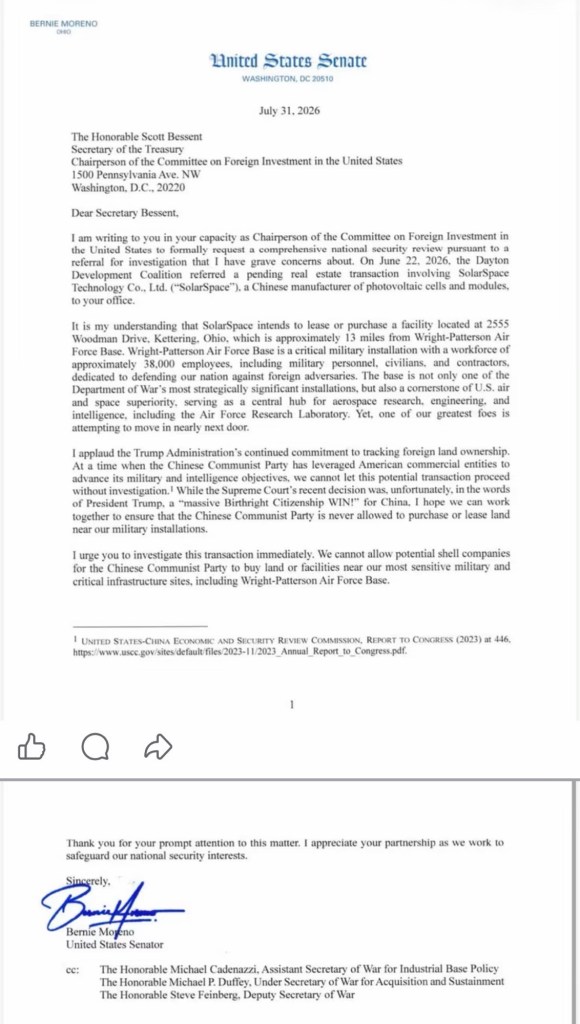
In the letter above…
“It is my understanding that SolarSpace intends to lease or purchase a facility located at 2555 Woodman Drive, Kettering, Ohio, which is approximately 13 miles from Wright-Patterson Air Force Base.”
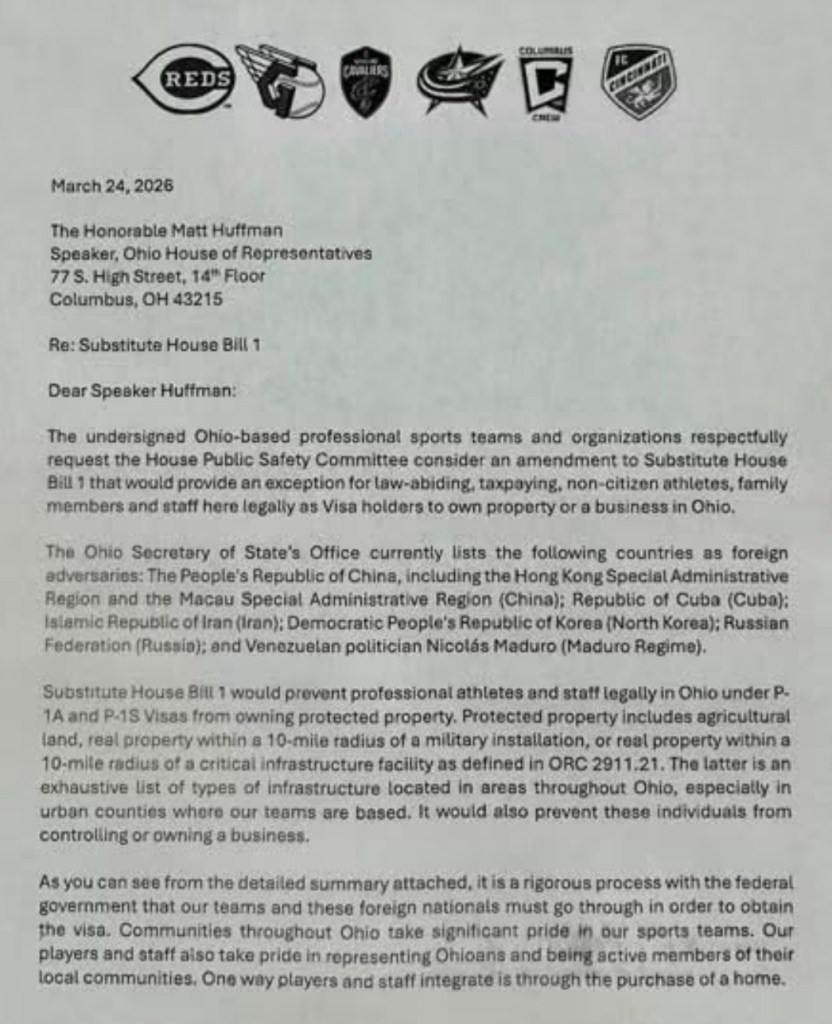
State Rep. Angie King (R-Celina) is one of the two main sponsors of House Bill 1.
From King’s social media—-
Ohio HB 1 was on track for a vote until professional sports interests stepped in.
It is ridiculous that professional sports organizations can get the attention of committee leadership while legislation protecting Ohio’s land and national security sits stalled.
Our obligation is to Ohioans not foreign millionaire athletes.
Ohio House Bill 1
Ohio House Bill 1 (136th General Assembly, 2025–2026) is known as the Ohio Property Protection Act.
Main Purpose
It expands restrictions on the acquisition and ownership of certain real property in Ohio by specified foreign governments, businesses, and individuals from countries designated as “foreign adversaries” by the U.S. Secretary of Commerce (currently including China, Cuba, Iran, North Korea, Russia, and Venezuela under the Maduro regime).
Key elements include:
• Prohibitions on acquiring agricultural land.
• Prohibitions on acquiring “protected property,” defined as real property within 10 miles of a military installation or critical infrastructure facility (reduced from an earlier proposed 25-mile radius).
• Critical infrastructure is defined broadly and includes power plants, dams, water treatment facilities, refineries, electrical transmission/distribution systems, telecommunications infrastructure (including poles, lines, cell towers, and fiber optic cables), railroads, pipelines, and similar facilities. Critics note this could effectively cover large portions of the state.