
This posting is to compare the fall of the Roman Empire and a comparison in how the USA might mirror that.
ChatGPT…was used twice to give an unbiased look at the two questions that were asked.
(2-19-26) The fall of the Roman Empire wasn’t caused by just one thing—it was a long, gradual decline driven by multiple problems happening at the same time. Here are the main reasons historians point to:
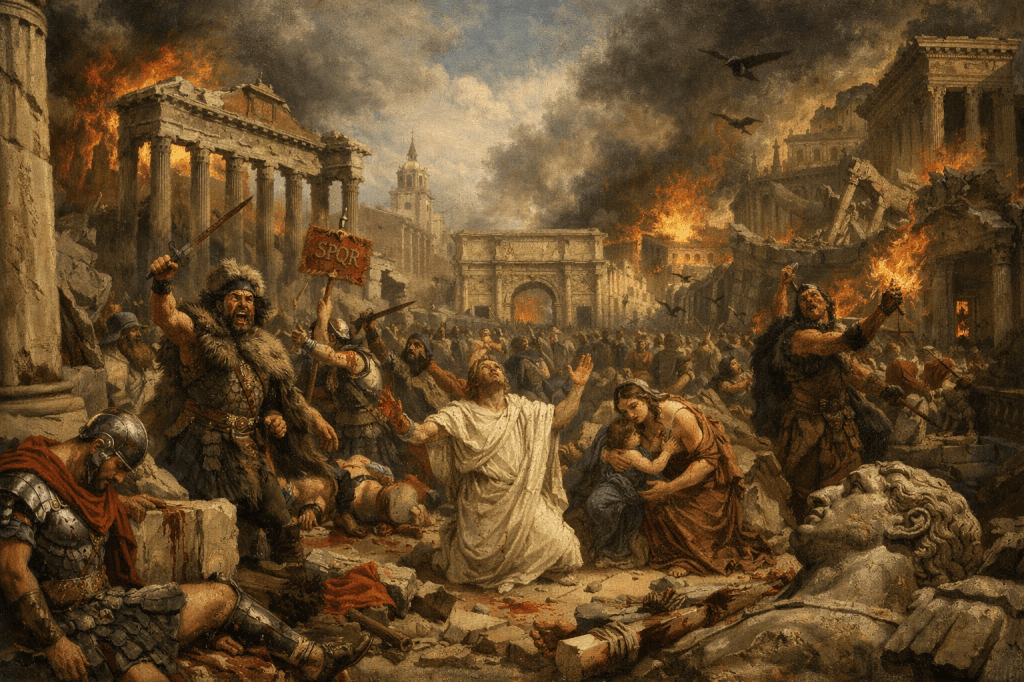
1. Political Instability & Corruption
After the height of the empire under rulers like Augustus, leadership became increasingly unstable.
Frequent assassinations and civil wars Short reigns and power struggles Emperors chosen by the army rather than stable succession Government corruption and inefficiency
This made long-term planning and reform nearly impossible.
2. Economic Troubles
Rome’s economy weakened over time due to:
Heavy taxation on citizens Inflation from debasing currency Overreliance on slave labor (limited innovation) Costly military upkeep Declining trade and agricultural productivity
As revenue shrank, maintaining the empire became harder.
3. Military Problems
Rome’s army was once its greatest strength—but later became a vulnerability.
Overexpansion made borders hard to defend Increased reliance on foreign mercenaries Loyalty shifting from Rome to individual generals Constant pressure from outside groups
By the 4th and 5th centuries, Roman legions were not as disciplined or dominant as before.
4. Barbarian Invasions
Germanic tribes and other groups increasingly pushed into Roman territory.
Key moments include:
The sack of Rome by the Visigoths in 410 The invasion of the Huns under Attila The final deposition of the last Western Roman emperor, Romulus Augustulus, in 476
This marked the traditional “fall” of the Western Roman Empire.
5. Division of the Empire
In 285 AD, Diocletian divided the empire into Eastern and Western halves to improve management.
The Eastern Roman Empire (later called the Byzantine Empire) survived for nearly 1,000 more years. The Western half was weaker economically and militarily, and it collapsed first.
6. Social Decline & Loss of Civic Virtue
Some historians argue that:
Citizens became less engaged in public life Wealth inequality grew Moral and civic responsibility declined
Though debated, many believe internal decay weakened Rome from within.
7. Plagues & Population Decline
Epidemics like the Plague of Cyprian reduced the population, shrinking the workforce and military recruitment pool.
In Short
The Western Roman Empire fell in 476 AD because of:
Weak leadership Economic collapse Military decline Invasions Internal division
It wasn’t a sudden crash—it was a slow unraveling over centuries.
Based on ChatGPT — Reasons for the fall of the Roman Empire
Comparisons between the modern United States and the Roman Empire usually focus on power, culture, military reach, and internal challenges. Here’s a balanced breakdown:
🏛 Political Structure
🇺🇸 United States
Federal constitutional republic (since 1789) Elected president, Congress, independent judiciary Regular elections and peaceful transfers of power (core principle)
Began as a republic; transitioned to imperial rule under Augustus in 27 BC Emperor held ultimate authority Senate remained but gradually lost real power
Comparison:
Some argue the U.S. resembles late Roman Republic dynamics more than the Empire—polarization, strong personalities, and institutional stress.
⚔️ Military Power
🇺🇸 United States
Most powerful military globally Hundreds of overseas bases Navy dominates global sea lanes
🏺 Rome
Controlled vast territories across Europe, North Africa, and the Middle East Legions stationed across the empire Relied on both citizen-soldiers and later mercenaries
Comparison:
Both projected power far beyond their homeland and maintained global (or regional-global) dominance.
💰 Economy & Currency
🇺🇸
World’s largest economy (nominal GDP) U.S. dollar is global reserve currency High national debt
🏺 Rome
Controlled key trade routes Relied heavily on taxation and conquest Debased currency in later years, leading to inflation
Comparison:
Concerns about debt, currency stability, and wealth inequality often mirror discussions of Rome’s later economic struggles.
🏙 Infrastructure & Influence
🇺🇸
Interstate highway system Technological dominance (Silicon Valley, AI, space) Cultural influence via Hollywood, music, and media
🏺 Rome
Built roads, aqueducts, amphitheaters Spread Latin language and Roman law Cultural assimilation of conquered peoples
Comparison:
Both shaped global systems—Rome through law and engineering; the U.S. through finance, technology, and media.
⚠️ Internal Challenges
Common comparison themes:
Political polarization Wealth inequality Immigration pressures Cultural shifts Declining trust in institutions
Rome faced:
Civil wars Government corruption Economic instability Pressure from outside groups (often called “barbarians” in Roman texts)
📉 Decline Narrative — Is It Fair?
Historians caution:
Rome declined over centuries, not overnight. The Eastern Roman Empire (Byzantine Empire) lasted another 1,000 years after the Western half fell in 476 AD. Empires don’t collapse for one single reason.
The U.S.:
Remains economically and militarily dominant. Has strong institutions compared to many historical empires. Faces real but not unprecedented internal tensions.
🧠 Big Difference
Rome was an expansionist territorial empire.
The U.S. is not a traditional territorial empire but exerts influence economically, militarily, and culturally.
Bottom Line
The comparison is useful as a cautionary lens—but not a prediction.
Rome teaches that:
Institutions matter. Internal division can be more dangerous than external threats. Economic stability underpins power. Adaptability determines longevity.
 Mercer County Outlook