
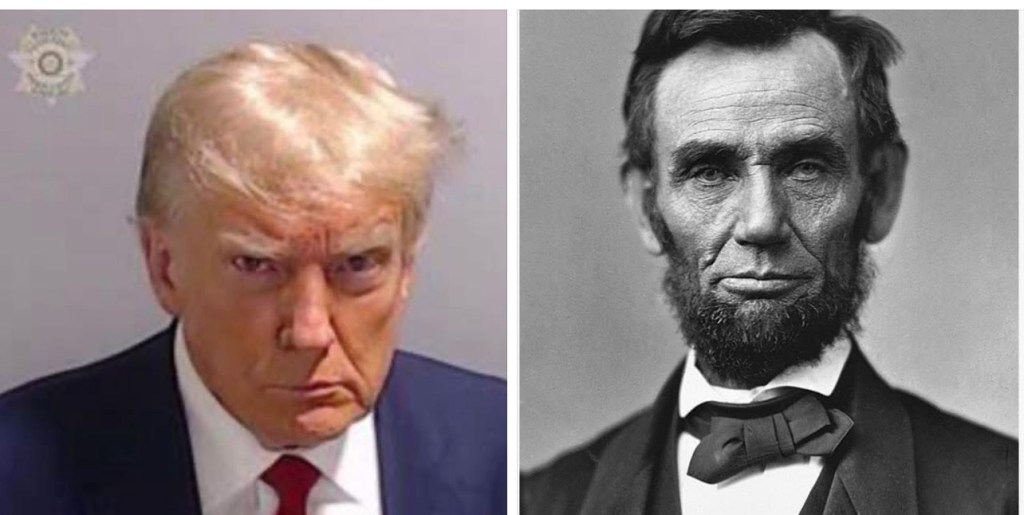
(11-29-25) Comparing the North-South Civil War from Abraham Lincoln’s tenure to Donald Trump’s current presidency shows what might have already started or is leading to another American Civil War.
Confusion and Anxiety – Lincoln and the Tensions Before the War
With his election, there were many Southerners who made it known they would rather kill Lincoln than suffer under his leadership. To begin his presidency, he traveled by train to the nation’s capital without his family. He cautiously changed trains and traveled in secrecy, trying to avoid any violence along the way. During the trip, Lincoln became aware of an assassination conspiracy against him and disguised his appearance. The trip took several days, with Lincoln stopping at small towns for the night. This trip embodied the anxiety of a nation clearly on the brink.
What southerners said about lincoln before the Civil War was fought
Before the Civil War (roughly 1850s through early 1861), Southern opinions about Abraham Lincoln were overwhelmingly negative, fearful, and often venomous. Southern newspapers, politicians, and public figures portrayed him as a dangerous radical who threatened the Southern way of life—especially slavery and states’ rights.
Richmond Enquirer (Virginia, 1860):
“Lincoln is a fanatic… pledged to the extinction of slavery… His election is a declaration of war upon the rights and institutions of the Southern people.”
Lincoln as an Ignorant, Low-Class Frontier Barbarian
Personal attacks were common, portraying Lincoln as crude and unfit.
• Charleston Mercury (1858, during Lincoln-Douglas debates):
Described Lincoln as
“the leanest, lankest, most ungainly mass of legs and arms and hatchet face ever strung upon a human frame.”
• Houston Telegraph (Texas, 1860):
“Lincoln is the ugliest man in the United States… a third-rate Illinois lawyer, an illiterate, ignorant, vulgar boor.”
In the eyes of most white Southerners in 1860–61, Lincoln was not just a political opponent—he was an existential threat. He was depicted as:
• A fanatic who would free the slaves by force
• A supporter of racial equality and interracial marriage
• A low-born tyrant who would coerce the South
• A man whose election alone dissolved any obligation to remain in the Union
The country is currently seeing the same comparisons to President Trump as the South did to President Lincoln. Both are Republicans and those with contempt for them are Democrats.
Overview of Democratic Views on President Trump in 2025
As of late 2025, nearly a year into Donald Trump’s second term, Democratic sentiments toward him remain intensely negative, characterized by deep distrust, fear of authoritarianism, and frustration over his policies. Polls consistently show overwhelming disapproval among Democrats and Democratic-leaning independents, with views framing Trump as a threat to democracy, the economy, and social norms. This opposition has fueled Democratic enthusiasm for the 2026 midterms, where anti-Trump messaging is central to their strategy.
Perceptions of Fascism: 87% of Democrats view Trump as a fascist, and 47% cite the “rise of fascism” as their top political concern.
Fascism is a far-right, authoritarian political ideology characterized by:
Core Features
Dictatorial leadership — a single leader or small ruling group with absolute power Ultra-nationalism — extreme nationalism that elevates the nation or race above all Suppression of opposition — censorship, political repression, and elimination of dissent Militarism — glorification of military strength and readiness for conflict State control of society — government influence over culture, media, education, and sometimes the economy Mythic past & propaganda — appeals to a “glorious past,” heavy use of propaganda, and emotional symbolism Anti-democratic values — rejection of liberal democracy, pluralism, and individual rights
These feelings are echoed across Democratic leaders, voters, and online discourse, where Trump is often portrayed as a “nightmare” or “emergency.”
Personal and Ethical Revulsion
Trump is often called a “liar,” “rapist,” and “child” in Democratic circles, with his family dynamics and pardons drawing scorn. Some X users note Democrats’ fixation on hating Trump overshadows self-reflection or family ties. Even minor events, like not applauding during speeches, are framed as principled resistance.
So what does the future hold for America? It’s to bad we don’t learn from the past…
 Mercer County Outlook
Gosh, I was thinking more about how the regime is using masked federal agents, throwing people in unmarked vehicles to cart them away, and not affording “due process” to indivuals as a flash point. (This is not to even mention military patroling civilians in our streets.)
All of that is more extreme than what you are citing. My Bad.
LikeLike
this article and rhetoric is retarded obviously a Dem wrote it if he didn’t have to clean up the garbage the previous administration left behind this wouldn’t be a issue.
LikeLike