
(3-13-26) Monday night’s Celina City Council Committee of the Whole meeting, council members requested that city administrators develop beekeeping hives legislation and present it to them at 6:45 p.m. March 23, right before the next regular council meeting.
Overview Of State Beekeeping Regulations
Ohio regulates beekeeping to prevent the spread of pests and diseases, support pollination, and maintain public safety. Regulations typically cover apiary registration, disease monitoring, hive management practices, transport rules, and product handling. While some requirements are uniform across the state, local jurisdictions may add ordinances. Beekeepers should verify both state and local rules before starting or expanding an operation.
Apiary Registration And Documentation
Registering apiaries with the appropriate state agency is commonly required. Registration helps authorities track hive locations, monitor colony health, and respond to outbreaks. Documentation may include the number and location of hives, hive types, and owner contact information. Renewal periods and reporting obligations can vary, so timely updates are essential to remain compliant.
Apiary Registration
Apiaries require registration in Ohio with the Department of Agriculture. The registration forms must be submitted by June 1st annually, or within ten days of getting bees (O.R.C. 909.02). You can get the registration form here. The fee is $5.00 per apiary (an apiary includes multiple hives in a single location). Late registration requires an additional $10.00 fee per registration (this is a total fee and not per apiary).
Celina Mayor Jeff Hazel, who owns Hazelnut Coffee in Celina-
“I’m not against bees and honey, because I use probably 400 pounds of honey at the shop every year that’s local. So I use a lot of honey. I think this is a great idea, but we’ve got to think about … reactions for kids and people that would get stung. I’m not saying they’re going to go out and attack anybody, but if a child would wander in that yard, what happens?”
Councilman Joe Wolfe said a policy would have to designate appropriate beekeeping areas.
“I don’t really think you want to put them in the middle of a densely populated residential section. On the outskirts of town would work, but I don’t think back in the Kessler Addition where the houses are really tight.”
I think it’s going to just open up a can of worms. We haven’t had a whole lot of people asking for them. I mean, it’s not like we’ve got 50 people wanting to put hives in town. It’s very few.’
It seems City Council members did not do their homework before the meeting. Ohio guidelines shown above would suggest that local residents could have beehives in place as long as they follow the state guidelines and there is no current local legislation.
Rules and Ordinances In Ohio cities
AKRON: A permit from the Director Of Health is required to place a beehive in Akron (see above information on registering your apiary). The city of Akron does not have a separate permit for keeping bees (as of 5/13/2020) that I was able to locate. The apiary may not constitute a nuisance, cannot disturb the tranquility of the surrounding neighborhood, and cannot endanger the public health. The apiary must “be placed and maintained in a manner approved by he Director of Health.” The following restrictions may also be required:
- The back of the beehive may be no less than six feet from any adjoining residential property or to any public road or public right-of-way.
- The side of the beehive may be no less than fifteen feet from any adjoining residential property or to any public road or public right-of-way.
- The front of the beehive may be no less than twenty-five feet from any residential property or to any public road or public right-of-way.
- The front or entrance of a beehive shall not directly face residences of adjoining property owners.
- No person shall place or keep an apiary, or cause or allow an apiary to remain on land not owned or possessed by such person, without first obtaining the written permission to do so of the owner or person lawfully in possession of such land.
- Every person owning, possessing, or controlling an apiary shall maintain within ten feet of each apiary a supply of water with a backflow prevention device which shall be equipped with a float valve or similar device which assures an adequate accessible and usable supply of water for the bees.
Akron Code of Ordinances, Title 9 General Provisions, Chapter 92. Animals, Section 92.29. Beekeeping
CUYAHOGA FALLS: Beehives must be kept with removable combs in good condition. The number of beehives allowed on certain property types is as follows:
- No beehives are allowed on Small, Attached-Single Family, and Muli-Family Lots
- Up to 2 hives are allowed on a Standard Lot to Suburban Lot
- Up to 4 hives are allowed on a Low Density Lot
- Up to 6 hives are allowed on a Large Lot
- Up to 8 hives are allowed on a Rural Lot
- Beehive quantities are subject to Major Site Plan Application procedures for Agro Businesses, Farming Operations, or Employment Zone (E-1) Businesses
Hives may not be kept closer than 15ft of any lot line or public right-of-way. The entrance needs to face whichever lot line or public right of way is furthest from the beehive location, or must face the beekeeper’s residence, and may only be kept in the rear yard. If a beehive is within 25ft of any property lines, is less than 10ft below grade, or the sole entrance does not face the beekeeper’s residence, a “flyaway barrier” is required. The “flyaway barrier” must be a solid fence or dense hedge, at least 6ft high, extending at least 2ft on either side of the hive, and located within 5 ft of the hive. It must be placed along the entrance side of the beehive. A fresh water supply must be maintained in a location readily accessible to all the bee colonies on the site throughout the day, and it must be closer the he bees than any other water source not owned by the property owner. Africanized bees are not permitted. All State of Ohio rules and regulations must also be complied with, and the property owners keeping the bees must post a copy of their certificate of registration (from the Ohio Department of Agriculture) on or near their hives.
Part 11 City Code of Ordinances, 3.133(6) (see pages 215-216)
TALLMADGE: I was unable to find specific rules regarding beekeeping or apiaries for this location. You may want to contact the city offices directly.
MUNROE FALLS: I was unable to find specific rules regarding beekeeping or apiaries for this location. You may want to contact the city offices directly.
STOW: I was unable to find specific rules regarding beekeeping or apiaries for this location. You may want to contact the city offices directly.
Backyard garden pollinator kits…
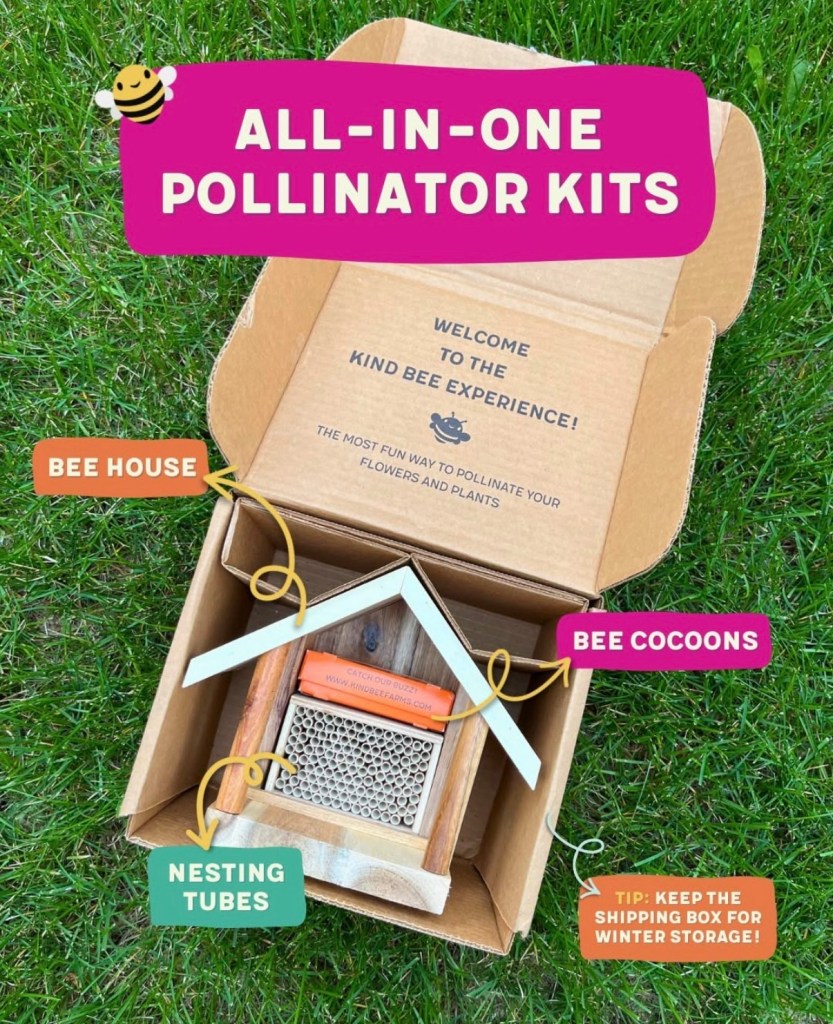
Everything you need to welcome pollinators to your garden, packed in one kit! 🐝🌸
Every Kind Bee Pollinator Kit comes with:
🏠 A sturdy bee house for your leafcutters to call home
🌿 Nesting tubes for cozy, safe spots to lay eggs
🐝 250 leafcutter bee cocoons to get your garden buzzing
Perfect for beginners and experienced gardeners alike, this kit makes it easy to support pollinators and boost your garden’s blooms 🌸
💡 Bonus Tip: Don’t throw away the shipping box! It’s perfect for storing your bee house and nesting tubes safely through the winter.
🐝 Preorders for Spring 2026 are NOW OPEN! Secure your kit and get ready for a buzz-worthy season.
 Mercer County Outlook