
Courtesy Lake Improvement Association
2-24-26 Wright State University-Lake Campus biology professor Dr. Stephen Jacquemin explains why we’re seeing so many fish frozen in the ice at Grand Lake.
Winter Mortality of Gizzard Shad
Dropping temperatures during winter – eventually leading to ice on situations – can lead to stressful conditions for certain species of fish in Grand Lake St. Marys. This is particularly evident this time of year as thousands of individual fish can seen ‘frozen’ in the ice.
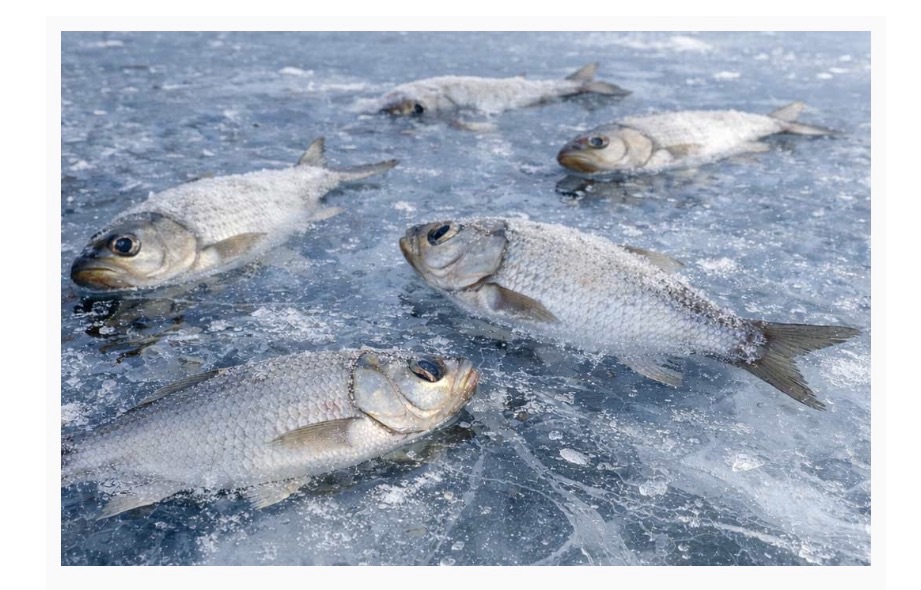
Most notably, the vast majority (well over 95% – based on a recent visual survey of the channels surrounding the Duckfoot and Behms area) of these individuals are all representative of one species, Gizzard Shad (Dorosoma cepedianum). These large numbers of dead ‘shad’ are a function of a natural phenomenon called ‘winterkill’, and while it can be striking to see this time of year it is not surprising given this particular species’ well documented sensitivity to rapid downticks in temperature as well as certain water quality conditions that coincide with long periods of ice cover formations.
Grand Lake St Marys is by no means the only lake in Ohio experiencing this, as this phenomenon is quite common during harsh winters. Interestingly, as these fish become dislodged from the ice with warming temperatures in the spring they become an important food source for other fishes (especially catfish) foraging on the lake bottom, invertebrates in their larval stages, waterfowl (like Great Blue Herons) wading the shoreline, and even small mammals (such as Raccoons) roaming the shorelines at night. In effect, these dead fish will see their nutrients recycled throughout the aquatic (and even terrestrial) ecosystems in the weeks or months to come.
If anyone is interested in more information pertaining to winter mortality of Gizzard Shad – check out the following article published by the American Fisheries Society – William W. Fetzer, Thomas E. Brooking, James R. Jackson, Lars G. Rudstam, Overwinter Mortality of Gizzard Shad: Evaluation of Starvation and Cold Temperature Stress, Transactions of the American Fisheries Society, Volume 140, Issue 6, November 2011, Pages 1460–1471, https://doi.org/10.1080/00028487.2011.630281
If anyone is interested in more information pertaining to the fish community in Grand Lake St. Marys – check out the following article published in American Midland Naturalist – Stephen J. Jacquemin, Mark S. Cubberley “Documentation of a Massive Fish Die Off on Grand Lake St. Marys, with Notes on Long-term Changes in Fish Assemblage and Watershed Habitat Over the Past Century,” The American Midland Naturalist, 187(1), 104-112, (3 January 2022) https://research.wright.edu/en/publications/documentation-of-a-massive-fish-die-off-on-grand-lake-st-marys-wi-2/
Gizzard Shad
The gizzard shad (Dorosoma cepedianum), also called mud shad, is a member of the herring family native to fresh and brackish waters across most of the continental United States, Canada, and Mexico. Named for its muscular, gizzard-like stomach that grinds consumed food, this silvery fish plays a crucial ecological role as a prolific filter feeder and forage species for game fish like bass and catfish.
 Mercer County Outlook