
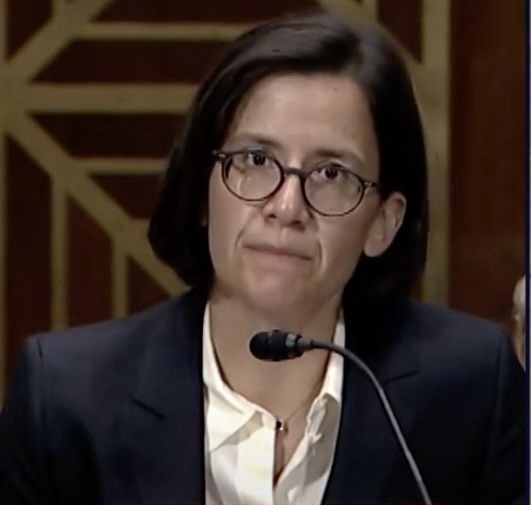
(2-3-26) U.S. District Court Judge for the District of Columbia Ana Reyes issued a ruling postponing the effective date of the Trump administration’s cancellation of TPS for Haitians. The order, the result of a case filed in July, lists no end date.
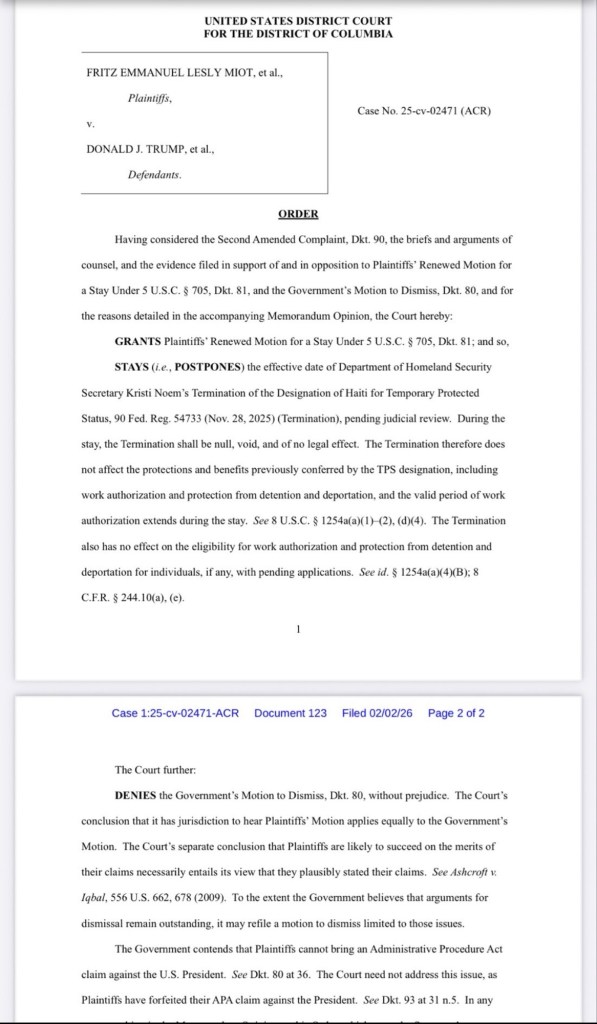
Reyes’ ruling says the termination of TPS is “null, void and of no legal effect” and will not impact the work authorization of Haitian immigrants. Those under TPS will also be protected from detention of deportation for the length of the judicial stay.
Reyes’ 83-page decision says that the Trump administration, particularly Department of Homeland Security Secretary Kristi Noem, predetermined that TPS for Haitians would be revoked without researching what that would mean for the more than 300,000 people legally residing in the United States.
Reyes wrote-
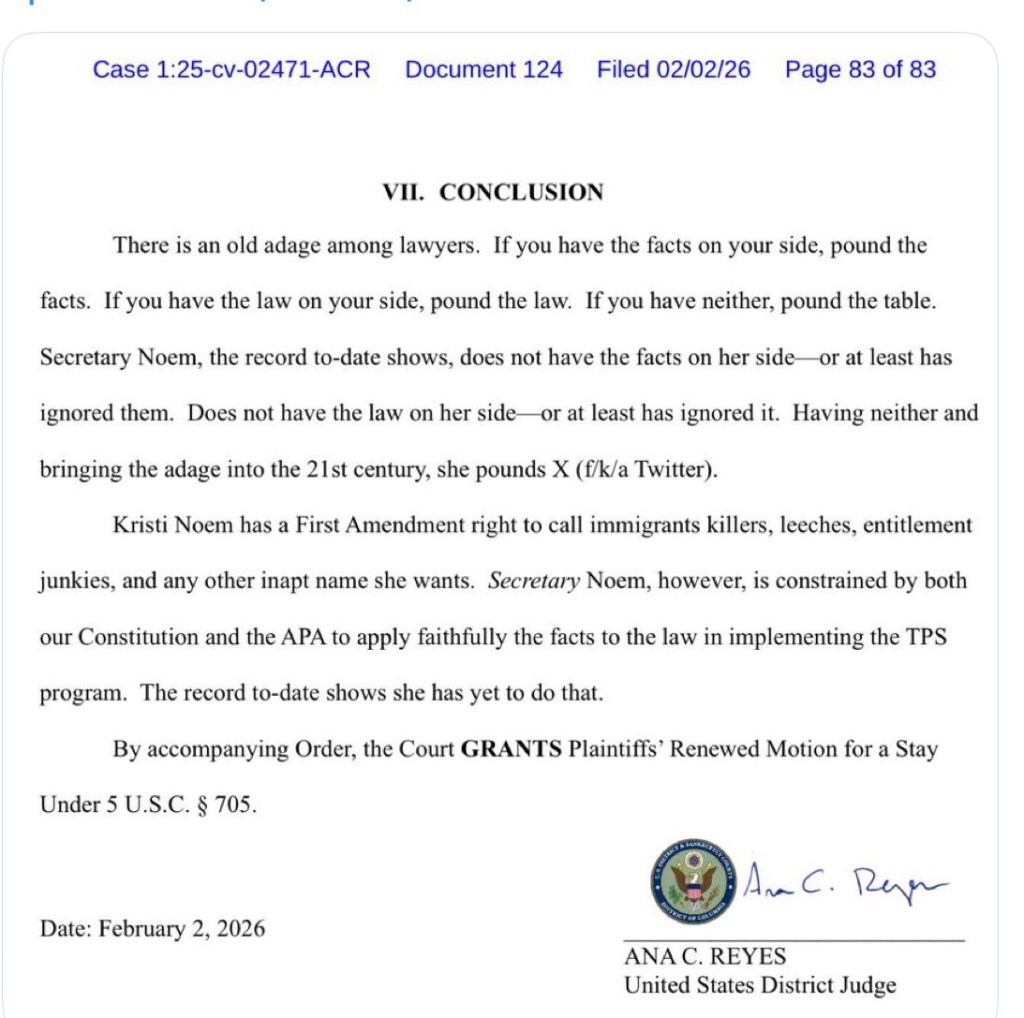
“There is an old adage among lawyers. If you have the facts on your side, pound the facts. If you have the law on your side, pound the law. If you have neither, pound the table. Secretary Noem, the record to-date shows, does not have the facts on her side — or at least has ignored them. Does not have the law on her side — or at least has ignored it. Having neither and bringing the adage into the 21st century, she pounds X (the social media platform formerly known as Twitter).”
TPS allows about 350,000 Haitians to legally live and work in the United States, had been set to to expire today. It includes about 30,000 Haitians in central Ohio and another 15,000 in Springfield.
District Judge Ana C. Reyes
Judge Reyes was appointed as a United States District Judge in February of 2023, assuming the seat previously held by Judge Colleen Kollar-Kotelly.
Judge Reyes served as a law clerk to Judge Amalya L. Kearse on the U.S. Court of Appeals for the Second Circuit (2001). After clerking, Judge Reyes became a litigation attorney at Williams & Connolly LLP, where she spent her legal career from 2001 to 2023. While there, she served as the co-chair of the firm’s International Disputes practice group and on its Executive Committee. Her practice focused on international litigation, representing foreign governments, foreign government officials, and multinational companies. Judge Reyes also worked on patent, legal malpractice, and other complex civil litigation matters.
Judge Reyes devoted substantial pro bono time to assisting refugees and organizations that assist refugees in obtaining asylum, including the United Nations High Commissioner for Refugees and Human Rights First. In 2016, she received the Legacy Award from Unlikely Heroes for her successful representation of young women escaping persecution by a regional terrorist organization. The Legal Times has recognized her as a “Champion” for her pro bono efforts (2009).
In 2023, the Hispanic National Bar Foundation presented Judge Reyes with its “Judicial Leadership Award,” which recognizes excellence in the legal profession. While in private practice, Judge Reyes earned accolades from The Legal 500 as a “Leading Lawyer” (2023) and “Next Generation Lawyer” (2020-2022) in International Litigation and from Benchmark Litigation as a “Local Litigation Star” (2019-2023). The National Law Journal recognized her multiple times, including on its Outstanding Women Lawyers list recognizing “the 75 most accomplished female attorneys working in the legal profession today” (2015); as an “Immigration Trailblazer” (2018); a Washington D.C. “Rising Star” (2014); and as a Minority 40 Under 40 (2011). In 2017, the Women’s Bar Association of D.C. named her as its “Woman Lawyer of the Year.”
Judge Reyes was born in Montevideo, Uruguay, and grew up in Louisville, Kentucky. She received her J.D., magna cum laude, from Harvard Law School (2000), her M.I.P.P., with honors, from the School of Advanced International Studies at Johns Hopkins University (2014), and her B.A., summa cum laude, from Transylvania University (1996). Along with her admissions to bars of the United States, Judge Reyes was listed on the Roll of Solicitors in England and Wales. Judge Reyes co-taught Advocacy in International Arbitration as a Clinical Visiting Co-Lecturer at Yale Law School (2018, 2019) and co-taught Trial Practice, Experts at Georgetown University Law School (2017).
 Mercer County Outlook