
(12-27-24) Yesterday was the first day of the The Kwanzaa celebration.
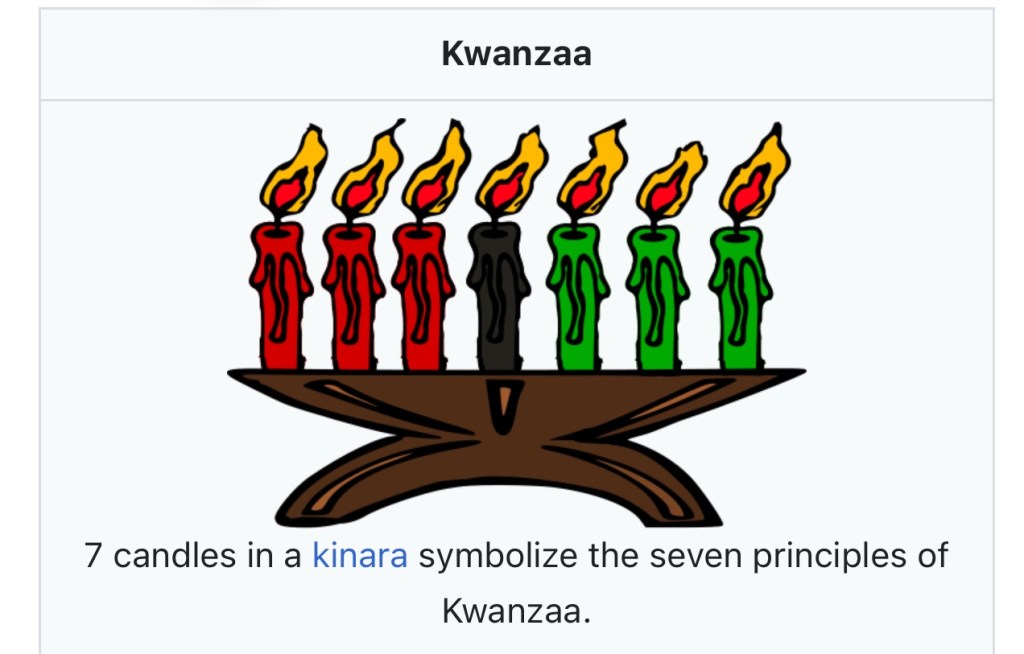
Details of the founding and why it is celebrated.
Vice-President Harris talks about celebrating Kwanzaa….
Kwanzaa (/ˈkwɑːnzə/) is an annual celebration of African-American culture from December 26 to January 1, culminating in a communal feast called Karamu, usually on the sixth day.[1] It was created by activist Maulana Karenga, based on African harvest festival traditions from various parts of West, East, as well as Southeast Africa. Kwanzaa was first celebrated in 1966. Twenty-first-century estimates place the number of Americans who celebrate Kwanzaa between 500,000 and 2,000,000.
Maulana Karenga
Born in Parsonsburg, Maryland, to an African-American family, Karenga studied at Los Angeles City College and the University of California, Los Angeles.
He was active in the Black Powermovement of the 1960s, joining the Congress of Racial Equality and Student Nonviolent Coordinating Committee. In 1965, Karenga and Hakim Jamal co-founded the black nationalist group US Organization, which became involved in violent clashes with the Black Panther Party by 1969.
In 1971, he was convicted of felony assault, torture, and false imprisonment of women. He denied involvement and claimed the prosecution was political in nature. Karenga was imprisoned in California Men’s Colony until he received parole in 1975.
In 1966, Karenga notably created Kwanzaa, modeling the holiday after the African “first fruit” traditions. The rituals of the holiday promote African traditions, including the “seven principles of African heritage”. During the early years of Kwanzaa, Karenga said it was meant to be a black alternative to Christmas. Karenga, a secular humanist, challenged the sanity of Jesus and declared Christianity a “White religion” that black people should shun. However, Karenga later changed his opinion, stating that Kwanzaa was not meant to provide people with an alternative to “their own religion or religious holiday”.
 Mercer County Outlook