
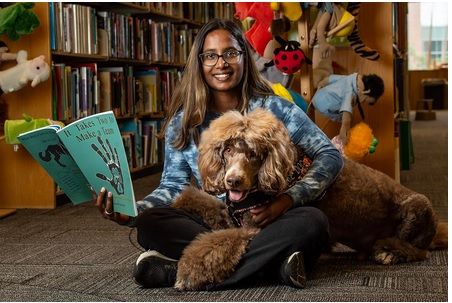
(7-14-23) Anjali Edwards wanted to educate the public — especially young people — on the etiquette of how to approach service animals and the people they help. So she interviewed eight people who use service animals, wrote their stories and illustrated a book with drawings of them and their animals.
Then there was one more service dog/person story to include: her own.
The result by the 2022 Wright State University graduate is “It Takes Two to Make a Team: How Service Animals Can Change the Lives of their Handlers,” which became available in print in June.
Edwards, a Bellbrook resident who earned her bachelor’s degree in psychology and a minor in business from Wright State in December 2022.
“A lot of people know about service dogs who are for veterans with PTSD and guide dogs for the blind or vision impaired. But I wanted to raise awareness of other service dogs. I wanted to show that people of all different ages and backgrounds and many different types of disabilities can have a service dog.”
Edwards said it was also important to raise awareness of how to act around service dogs, and that it’s important not to distract them while they are at work.
Edwards’ service dog is Teddy, a 5-year-old, 60-pound Labradoodle. Edwards has fibromyalgia, which causes chronic pain; postural orthostatic tachycardia syndrome, which affects blood flow and causes lightheadedness, and Ehlers-Danlos syndrome, which affects joints and connective tissues.
“He’s a multipurpose service dog. He’s not specifically tasked to mitigate one disability. He helps with mobility. He picks up items, like a phone, wallet, car keys, his leash from the ground.”
Edwards sometimes uses a motorized wheelchair, and Teddy can press the button that activates it.
“He also helps with panic attacks and anxiety. He provides deep pressure therapy. He applies weight to specific parts of my body that release chemicals to help me calm down.”
It’s the same principle as when those with anxiety use a weighted blanket, she said-
“but he’s better than a blanket because he’s soft and furry.”
Edwards began working on the book three years ago, inspired by her Wright State research projects in the Applying Scientific Knowledge (ASK) program.
One of her professors was William Romine, Ph.D., associate professor of biological sciences and director of the Data Science for Education Laboratory.
“A lot of the work in my lab is student-driven and Anjali’s work is no exception. Anjali began in my lab working on development of systems to detect changes in mental effort during studying using physiological sensor data. However, during my work with her, I learned that she was an advocate for students with disabilities, with a particular interest in students with service animals.”
Edwards worked in the Office of Disability Services and with Raiders on the Autism Spectrum Excelling (RASE).
“Through that program, I brought Teddy in and helped students. That solidified the idea that I wanted to work with people, especially those with autism.”
All the while she worked on the book, interviewing, writing, illustrating.
“I’m a self-taught artist.”
She published “It Takes Two to Make a Team” through Kindle Direct Publishing, and it is available on Amazon.
Romine added –
“She is also an amazing artist, so we decided that writing a fun and informative resource aimed at educating people of all ages about service animals would be a fitting application of her talents and passion.”
Edwards said the reason she chose Wright State was its reputation for accessibility. Wright State is ranked in the top three most-accessible schools in the country.
“I needed a campus that had working elevators — others had elevators that didn’t necessarily work – and was super accessible.”
She also praised Wright State for its service dog park.
Edwards said having a service dog is not novel.
“We’re like the average person, we just happen to have a service dog,” she said.
However, the combination of her three chronic illnesses can often leave her quite fatigued. A simple shopping outing can often turn into an ordeal that takes much longer than it would for most people.
“I want to pick up cereal, milk, eggs and be on my way. A five-minute trip like that for other people takes me 20 to 30 minutes because people stop and ask to pet my dog and ask what’s wrong with me. Sometimes if I feel like it. I will stop and answer questions. But if I am in a lot of pain or super tired, answering questions is not on my to-do list.”
That’s why she lets the book do her talking.
Edwards said the book’s target audience is children ages 8 to 12 but any age group can learn from it.
“Those are the ages where kids recognize that there are people different from them, are willing to understand why and are interested in wanting to know why. The book teaches children that this is the correct way to interact with a person with a service dog. It’s a perfect time for reading about and understanding diversity and inclusion.”
Romine said –
“It’s been really inspiring seeing her finish this and get it out for others to read. I think it could make a big impact toward improving the public’s understanding of service animals and how they are utilized to make our world more accessible for people with disabilities.”
Additional news stories, media resources and media contacts can be found on the Wright State Newsroom or the Office of Communications website.
A Carnegie-classified research university, Wright State University’s main campus is 12 miles northeast of downtown Dayton, Ohio, near the historic landmarks where the Wright brothers taught the world to fly. The university operates a branch campus, Wright State University–Lake Campus, on the shores of Grand Lake St. Marys in Celina, Ohio. Wright State serves nearly 14,000 students and offers nearly 300 undergraduate, graduate, doctoral, and professional degree programs through eight colleges and three schools, including Professional Psychology and the Boonshoft School of Medicine. For more information, please visit: www.wright.edu.
 Mercer County Outlook